ज्ञानं परमं ध्येयम् · The Highest Goal is Knowledge
The world's first AI-powered research portal for Indological studies. Decode Sanskrit manuscripts, map philosophical traditions, and explore five millennia of Indian civilisation.
Indology.AI brings together the rigour of classical scholarship and the reach of modern AI. We index 50,000+ manuscripts, power Sanskrit natural-language processing, and build the world's most comprehensive knowledge graph of Indian civilisation — so that every scholar, student, and curious mind can access the depth of 5,000 years of recorded thought.
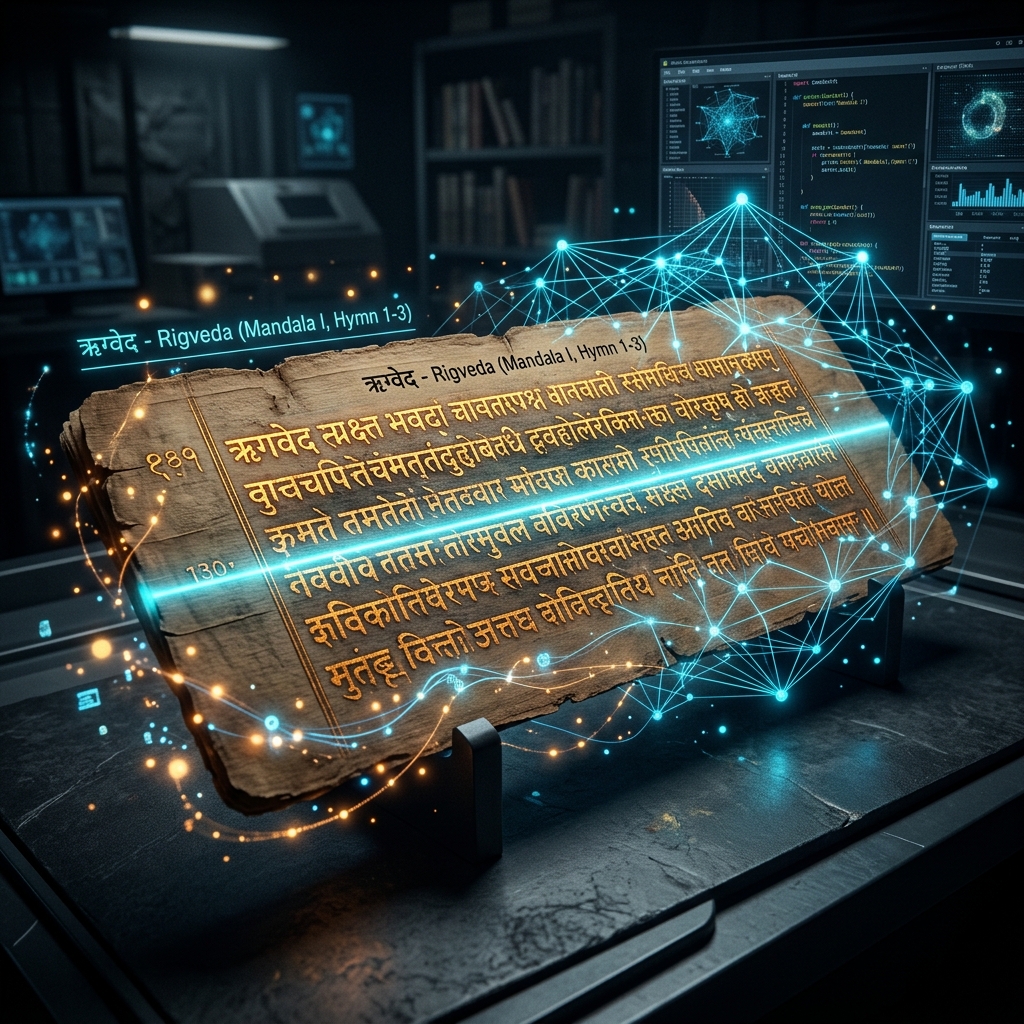
Parse, translate and semantically analyse Sanskrit texts with language models trained on the entire classical corpus — Vedas, Upanishads, Puranas, Sutras and commentaries. Supports Devanagari, IAST, Harvard-Kyoto and SLP1.
सर्वे भवन्तु सुखिनः
"May all beings be happy"
Yajurveda 36.17 · 98% confidenceUpload any scanned manuscript — palm leaf, paper, copper plate — and receive AI-transcribed, searchable text with confidence scoring, script identification across 28 Indic scripts, and palaeographic dating estimates.
Navigate all six orthodox Darśanas and the rich landscape of Buddhist, Jain and heterodox traditions through our AI-built interactive knowledge graph — tracing lineages, debates, key thinkers and primary texts.
Explore 5,000 years of Indian civilisation on a dynamic, AI-enhanced timeline. Connect events, dynasties, texts and cultural milestones across time and geography with correlated cross-civilisational context.
A suite of AI tools designed for every dimension of Indological scholarship.
May all beings be happy.
May all be free from disease.
May all see auspiciousness.
May none suffer.
Trained on millions of verses from Vedas, Upanishads, Puranas, Sutras and classical literature. Understands Sandhi, Samāsa, Kāraka resolution, and source attribution — all in a single query.
Start translating →
Upload scanned manuscripts in any Indian script and receive AI-transcribed, searchable text with confidence scoring, script identification and palaeographic dating estimates accurate to within 50 years.
Try OCR engine →Ask complex questions about Indian philosophy, history and culture. Our AI is trained on authoritative Indological sources — every answer is grounded in primary texts with full citations.
Start a conversation →Explore interconnected civilisational knowledge — people, texts, places and ideas — through an AI-built dynamic graph that surfaces connections invisible to traditional research methods.
Explore the graph →All four Vedas, 108 Upanishads, Brahmanas and Aranyakas with AI-assisted commentary and cross-references.
Dynasties, kingdoms, rulers, battles and archaeological evidence from the Indus Valley to the Vijayanagara Empire.
All six orthodox Darśanas plus Buddhist, Jain and heterodox traditions with primary text access and lineage mapping.
Temple architecture, sculpture, iconography and visual traditions searchable by period, style and regional school.
Astronomy, mathematics, medicine, architecture, linguistics — each discipline indexed and cross-referenced with primary sources.
Sanskrit, Prakrit, Pali, Tamil Sangam literature and 28 classical Indic scripts with full transliteration support.
Indology.AI is a mission-driven initiative built on collaboration between AI engineers, classical scholars, linguists and passionate volunteers. There are many ways to contribute — no matter your background.
Help digitise and transcribe Sanskrit, Tamil, Telugu and other classical manuscripts from our partner libraries and archives. No prior training required — guided onboarding provided.
Native or advanced speakers of Sanskrit, Pali, Tamil, Kannada, Telugu or Persian can help verify AI translations and contribute scholarly annotations to the knowledge base.
Academics and researchers can contribute essays, articles, primary source analyses and bibliography to the Indology.AI encyclopaedia — credited and peer-linked.
Developers, ML engineers and linguists can contribute to our open-source Sanskrit NLP toolkit, OCR models and knowledge graph infrastructure on GitHub.
Questions, collaborations, media enquiries or manuscript contributions — we'd love to hear from you.